Space Infrastructure
Space infrastructure forms the orbital backbone of modern economic, civilian and military systems.
Orbital infrastructure enables communication, navigation, timing, observation and strategic coordination across the global system.
As societies become increasingly dependent on space-based systems, control over orbital infrastructure becomes a question of geopolitical leverage, strategic resilience and infrastructural power.
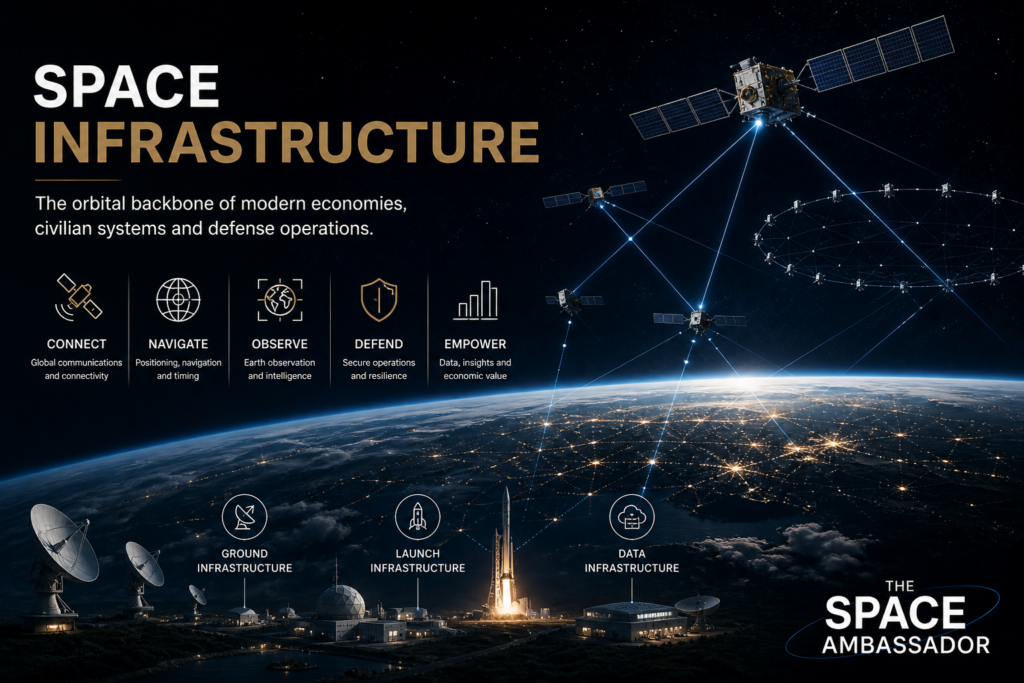
Definition
Space infrastructure consists of orbital and terrestrial systems that enable the operation, maintenance and coordination of space-based capabilities.
This includes satellites, launch systems, ground stations, communications networks, positioning systems, ISR platforms and orbital data infrastructure.
Space infrastructure is no longer isolated from terrestrial systems. It is deeply integrated into modern economies, logistics, communications, defense operations and critical infrastructure networks.
Space Infrastructure Layers
Orbital Systems
Satellites provide communication, navigation, observation, intelligence gathering and strategic coordination capabilities.
Ground Infrastructure
Ground stations, control centers, tracking systems and terrestrial communication networks enable orbital operations.
Launch Infrastructure
Launch sites, manufacturing systems and logistics chains form the physical foundation of orbital deployment capability.
Data Infrastructure
Space systems increasingly depend on integrated data ecosystems for operational coordination, navigation and strategic decision-making.
Civilian Infrastructure
Modern civilian systems increasingly rely on orbital infrastructure.
This includes:
- global communications
- GPS and navigation systems
- financial timing synchronization
- weather forecasting
- supply chain coordination
- emergency response systems
Disruptions in orbital infrastructure can therefore create cascading effects across civilian economies and public infrastructure systems. The European Space Agency describes space infrastructure as essential for communications, navigation and Earth observation systems.
Defense Infrastructure
Military operations increasingly depend on orbital systems for communication, positioning, intelligence gathering and operational coordination.
Space infrastructure now supports:
- ISR capabilities
- missile warning systems
- battlefield communications
- precision navigation
- strategic reconnaissance
This transforms orbital infrastructure into a strategic security asset and a potential vulnerability during geopolitical conflict. NATO recognizes space as an operational domain critical to defense and strategic coordination.
Commercial Control
Private companies increasingly control critical components of orbital infrastructure.
This includes:
- satellite constellations
- launch systems
- communications networks
- orbital data platforms
The concentration of infrastructure ownership in a limited number of actors creates new forms of dependency and infrastructure power.
Commercial infrastructure providers can influence access, resilience and strategic autonomy in the orbital domain.
Related Concepts
Space Infrastructure
Space infrastructure describes the orbital and terrestrial systems that support communications, navigation, observation and strategic coordination.
Dual-Use Space Systems
Dual-use systems operate across civilian and military domains, creating new forms of strategic dependency and infrastructure integration.
Orbital Dependency
Orbital dependency emerges when states or institutions rely on externally controlled orbital infrastructure for critical operational functions.
Related Frameworks
Infrastructure Capture
Infrastructure capture describes how control over critical orbital systems can generate political, commercial or strategic leverage.
The Orbital Dependency Index
The Orbital Dependency Index measures how dependent states or institutions are on externally controlled orbital infrastructure.
Strategic Orbital Chokepoints
Strategic orbital chokepoints are infrastructure concentration points that create leverage, vulnerability or systemic dependency.
FAQ
What is space infrastructure?
Space infrastructure consists of orbital and terrestrial systems that enable communications, navigation, observation, timing and strategic coordination.
Why is space infrastructure important?
Modern economies, defense systems and civilian infrastructure increasingly depend on orbital systems for operational continuity and strategic coordination.
How does orbital infrastructure create dependency?
States and institutions can become dependent on externally controlled space systems for communications, navigation, ISR and strategic timing functions.
Why does commercial control of space infrastructure matter?
Commercial actors increasingly control critical orbital systems, creating new forms of infrastructure concentration and strategic dependency.
Can space infrastructure become a geopolitical vulnerability?
Yes. Disruptions, concentration of control or external dependency in orbital systems can create significant geopolitical and infrastructural risks.
Space Infrastructure Is Power
Space infrastructure is no longer a peripheral technological system.
It has become a foundational layer of economic coordination, military operations and geopolitical influence.
As dependency on orbital systems grows, control over infrastructure becomes a defining source of strategic power.
Related Analysis:
- From Capability to Space Dependency
- Why the Ground Segment Matters More Than Satellites
- Space Infrastructure Is Already Political
THE SPACE AMBASSADOR
Space as Infrastructure. Infrastructure as Power.