Orbital Dependency
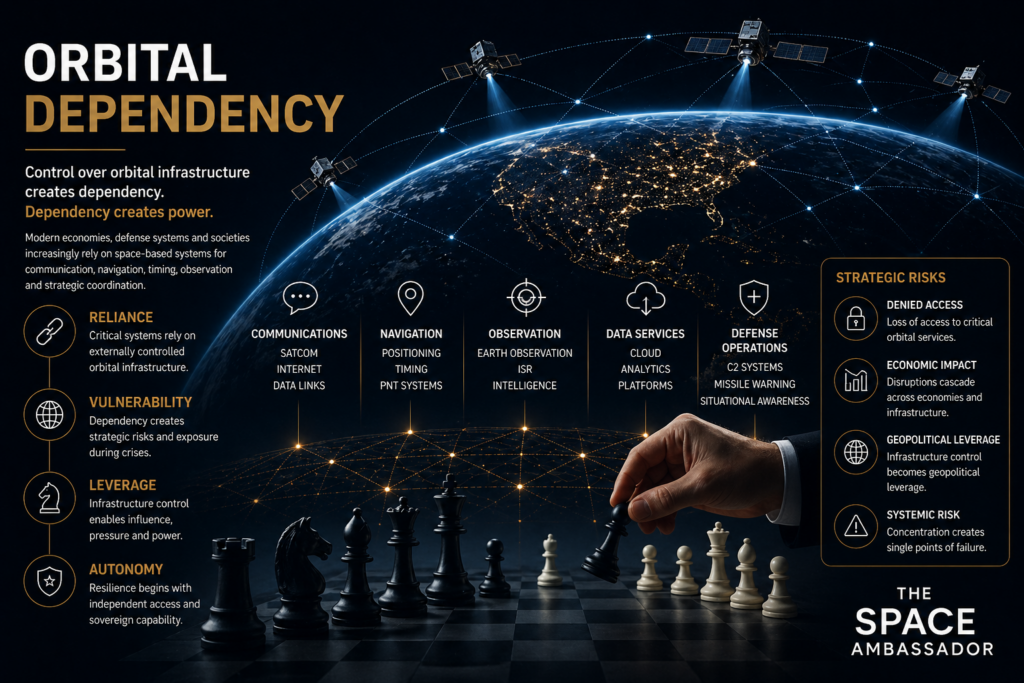
Orbital dependency emerges when states, institutions or societies rely on externally controlled orbital infrastructure for critical operational functions.
Modern economies, defense systems and civilian infrastructure increasingly depend on orbital systems for communication, navigation, timing, observation and strategic coordination.
As dependence on orbital infrastructure grows, control over these systems becomes a source of geopolitical leverage, strategic asymmetry and infrastructural power.
Definition of Orbital Dependency
Orbital dependency describes the strategic reliance on externally controlled space-based infrastructure for essential economic, civilian or military functions.
This reliance can emerge through reliance on:
- foreign satellite systems
- commercial orbital infrastructure
- external launch capabilities
- navigation systems
- communications networks
- ISR infrastructure
- orbital data systems
Orbital reliance is not limited to states.
Private companies, financial systems, logistics networks and defense organizations increasingly depend on orbital infrastructure for operational continuity.
Why Reliance Matters
Orbital Reliance Creates Strategic Vulnerability
Dependence on external orbital systems can create structural vulnerabilities during geopolitical crises, conflicts or infrastructure disruptions.
Actors without control over critical orbital infrastructure may lose operational autonomy during periods of instability.
Dependency Creates Power Asymmetries
Control over orbital infrastructure creates asymmetric relationships between infrastructure providers and dependent actors.
States or companies controlling orbital systems can influence:
- access
- operational continuity
- infrastructure resilience
- strategic coordination
Orbital Reliance Extends Beyond Defense
Orbital dependency increasingly affects civilian infrastructure systems including:
- communications
- transportation
- financial systems
- logistics
- emergency response
- energy infrastructure
This transforms orbital infrastructure into a foundational layer of modern society.
Types of Dependency
Launch Need
States without sovereign launch capability depend on external providers to deploy or replace orbital systems.
Navigation Reliance
Many economies and defense systems depend on externally controlled positioning and timing systems.
Communications Need
Satellite communication networks increasingly support civilian and military operations across global infrastructure systems.
ISR Reliance
Intelligence, surveillance and reconnaissance capabilities increasingly rely on orbital observation systems.
Commercial Infrastructure Dependency
Private companies increasingly control critical orbital infrastructure services.
This creates new forms of reliance on commercial infrastructure actors.
Strategic Risks
Political Leverage
Infrastructure providers may gain geopolitical leverage over dependent actors.
Infrastructure Disruption
Critical infrastructure systems increasingly rely on interconnected digital and orbital networks. Disruptions in orbital systems can create cascading failures across civilian and defense infrastructure.
Infrastructure Concentration
The concentration of orbital infrastructure ownership in a limited number of actors creates systemic vulnerability.
Strategic Autonomy Erosion
Long-term reliance on external orbital systems can weaken strategic autonomy and operational resilience. UNOOSA highlights the importance of sustainable and resilient orbital infrastructure systems for global stability.
Related Concepts
Orbital Dependency
Orbital dependency describes reliance on externally controlled orbital systems for strategic and operational functions.
Space Infrastructure
Space infrastructure forms the operational backbone of communication, navigation and strategic coordination systems.
Dual-Use Space Systems
Dual-use orbital systems operate across civilian and military domains, increasing infrastructure interdependence.
The OECD highlights the growing dependence of modern economies on orbital infrastructure systems and space-enabled services.
NATO identifies space systems as critical for communications, navigation and operational coordination across modern defense infrastructures.
FAQ
What is orbital dependency?
Orbital dependency describes reliance on externally controlled space infrastructure for communications, navigation, observation, timing and strategic coordination.
Why is orbital dependency important?
Modern economies, defense systems and infrastructure networks increasingly rely on orbital systems for operational continuity and strategic functionality.
How does orbital dependency create vulnerability?
Dependence on external orbital infrastructure can expose states or institutions to disruption, political leverage or operational instability.
Can commercial companies create orbital dependency?
Yes. Commercial infrastructure providers increasingly control critical orbital systems, creating new forms of strategic and operational dependency.
Why does orbital dependency matter for national security?
Military systems increasingly depend on orbital infrastructure for communications, ISR, navigation and operational coordination.
Dependency Is Power
Orbital reliance is reshaping geopolitical relationships in the infrastructure age.
As societies become increasingly dependent on orbital systems, control over infrastructure becomes a mechanism of leverage, influence and strategic power.
Understanding the need is therefore essential to understanding the future architecture of geopolitical power in orbit.
Related analysis:
- Why Satellite Dependency Rarely Feels Dangerous
- Civil Space Systems With Strategic Spillover
- The Myth of Optional Space Services
THE SPACE AMBASSADOR
Space as Infrastructure. Infrastructure as Power.