Space Governance
Space governance determines who controls the rules, infrastructure and power structures of the orbital domain.
As orbital systems become essential to communications, navigation, defense operations and economic coordination, governance increasingly shapes who controls access, infrastructure and strategic leverage in space.
Space governance is no longer limited to treaties and international law.
It increasingly concerns the governance of infrastructure power itself.
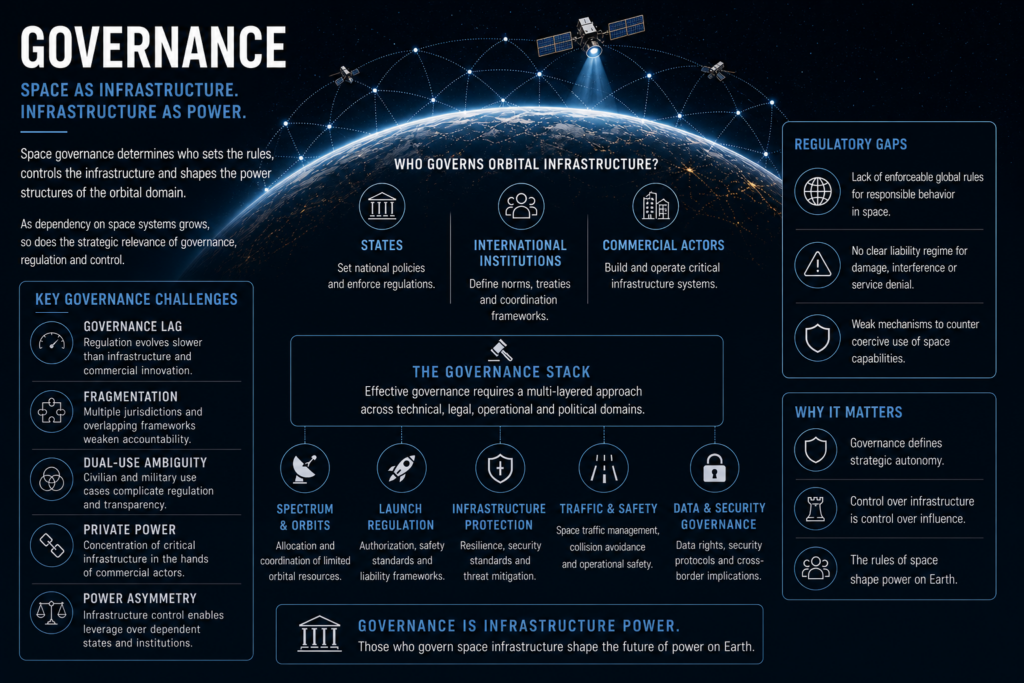
Definition of Space Governance
Space governance describes the political, legal and institutional frameworks that regulate activities, infrastructure and power relationships in outer space.
This includes:
- international treaties
- regulatory institutions
- national space policies
- orbital traffic coordination
- spectrum allocation
- launch regulation
- infrastructure control
- commercial governance structures
As orbital systems become deeply integrated into terrestrial infrastructure, governance increasingly influences geopolitical power distribution and strategic autonomy.
UNOOSA provides the core international space law treaties that shape the legal foundation of space governance.
Who Governs Orbital Infrastructure?
States
Nation states remain central actors in orbital governance through national regulation, military capabilities and strategic space policy.
States shape:
- launch authorization
- orbital regulation
- spectrum rights
- defense coordination
- infrastructure protection
The Outer Space Treaty remains the foundational legal framework for state activity in outer space.
International Institutions
International organizations attempt to coordinate norms, legal frameworks and operational standards for space activities.
However, governance fragmentation continues to grow as orbital activity accelerates.
Commercial Actors
Private companies increasingly control critical orbital infrastructure systems.
This includes:
- satellite constellations
- launch systems
- communications infrastructure
- orbital data platforms
Commercial actors now influence operational access, infrastructure resilience and strategic dependency patterns.
Regulatory Gaps in Space Governance
Infrastructure Governance Lag
Orbital infrastructure development is evolving faster than regulatory systems.
This creates governance gaps around:
- infrastructure ownership
- orbital congestion
- infrastructure dependency
- dual-use systems
- commercial infrastructure dominance
Jurisdictional Fragmentation
Governance remains fragmented across national jurisdictions and international institutions.
This weakens coordinated oversight of rapidly expanding orbital infrastructure systems.
Dual-Use Ambiguity
Many orbital systems operate across civilian and military domains.
This complicates regulation, accountability and strategic governance structures.
Private Infrastructure Power
Commercial actors increasingly operate infrastructure that entire economies and governments depend on.
This creates new forms of infrastructure power where private entities can influence:
- operational continuity
- communications access
- infrastructure resilience
- geopolitical leverage
- strategic dependency
The growing privatization of orbital systems raises fundamental governance questions about accountability and control.
Power: State vs Commercial Control
Strategic Autonomy
States dependent on privately controlled infrastructure may lose operational autonomy during crises or geopolitical conflicts.
NATO’s space policy frames space capabilities as sovereign assets under national jurisdiction and control.
Infrastructure Leverage
Infrastructure ownership creates leverage over dependent actors.
Control over orbital systems can influence political, military and economic decision-making.
Governance Asymmetry
Commercial infrastructure expansion increasingly outpaces governmental governance capacity.
This creates asymmetrical power relationships between infrastructure operators and dependent states or institutions.
Related Concepts
Orbital Governance
Orbital governance describes the systems, institutions and regulatory structures that shape power and coordination in the orbital domain.
Dual-Use Space Systems
Dual-use systems blur the boundary between civilian and military infrastructure operations.
Orbital Dependency
Dependency on externally controlled orbital systems creates governance vulnerability and strategic asymmetry.
Related Analysis
Infrastructure Capture
Infrastructure capture describes how control over critical infrastructure systems generates leverage and dependency relationships.
The Orbital Dependency Index
The Orbital Dependency Index measures structural dependency on externally controlled orbital infrastructure.
Strategic Orbital Chokepoints
Strategic orbital chokepoints are infrastructure concentration points capable of generating systemic vulnerability and governance leverage.
FAQ
What is space governance?
Space governance refers to the legal, political and institutional systems that regulate activities and infrastructure in outer space.
Why does space governance matter?
As societies increasingly depend on orbital systems, governance determines who controls infrastructure, access and strategic decision-making in space.
Who controls orbital infrastructure?
Orbital infrastructure is increasingly controlled by a mix of states, commercial actors and international regulatory systems.
Why are space governance gaps dangerous?
Weak governance structures can create instability, infrastructure concentration risks and regulatory asymmetries in critical orbital systems.
How do commercial actors influence space governance?
Commercial companies increasingly operate critical infrastructure systems that governments, economies and defense organizations depend on.
Governance Is Infrastructure Power
Governance is increasingly becoming governance of infrastructure itself.
As orbital systems become foundational to modern civilization, the question is no longer only who operates in space.
The question is who governs the infrastructure that societies depend on.
Related Analysis:
THE SPACE AMBASSADOR
Space as Infrastructure. Infrastructure as Power.