Access to Space
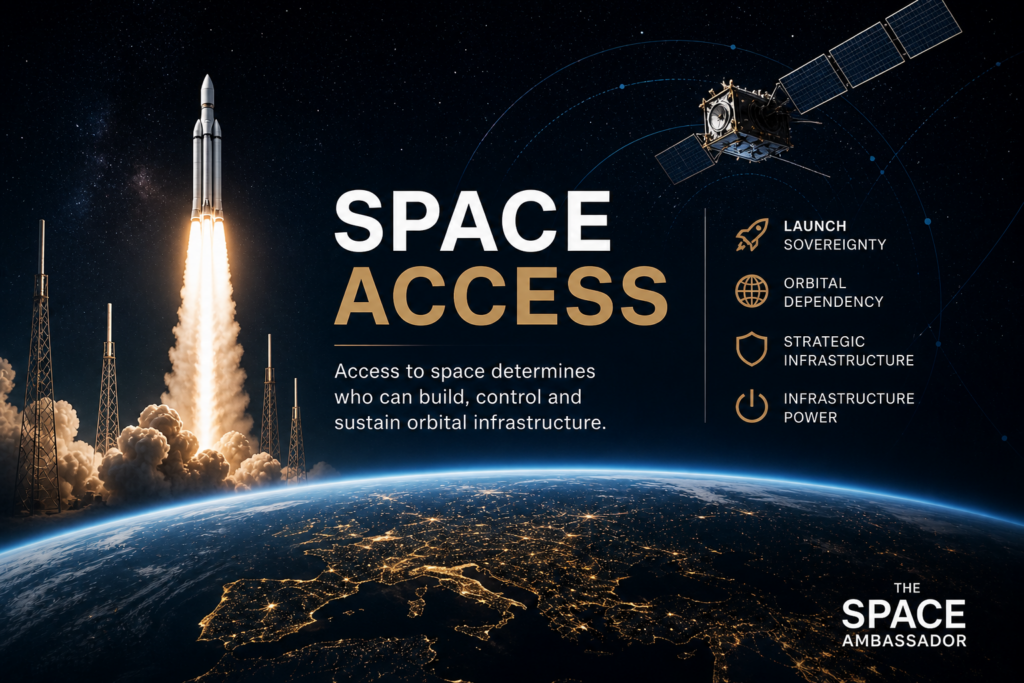
Orbital access determines who can build, control and sustain orbital infrastructure.
Access to space is not merely the ability to launch satellites.
It is the foundation of strategic autonomy in orbit.
States, alliances and commercial actors that control access to space control the deployment, maintenance and expansion of orbital infrastructure.
As orbital systems become critical for communications, navigation, ISR, logistics, timing and defense operations, access to space becomes a question of geopolitical leverage and infrastructural power.
INTRODUCTION
What Is Access to Space?
Access to space describes the capability of states, companies or alliances to independently deploy, maintain and sustain orbital systems.
This includes:
- launch capability
- launch infrastructure
- launch frequency
- reusable launch systems
- orbital logistics
- launch autonomy
- industrial launch ecosystems
- access to strategic launch sites
Access is not binary.
It exists on a spectrum between dependence and sovereignty.
Actors without independent launch access often depend on foreign governments or commercial providers to maintain critical orbital infrastructure.
WHY ACCESS MATTERS
Access Creates Strategic Power
Control over orbital access determines:
- who can deploy infrastructure into orbit
- who can rapidly replace lost assets
- who can scale orbital systems
- who can sustain military and civilian capabilities
- who becomes dependent on external launch providers
As space infrastructure becomes increasingly integrated into terrestrial systems, launch capability evolves from a technological capacity into a strategic infrastructure function.
Access and Infrastructure Dependency
States without launch autonomy risk dependency on external actors for:
- communications infrastructure
- navigation systems
- ISR capabilities
- strategic timing systems
- defense-related orbital services
This creates structural asymmetries between launch-capable and launch-dependent actors.
THE STRATEGIC DIMENSIONS OF ACCESS
1. Launch Sovereignty
Launch sovereignty describes the ability of a state or alliance to independently access orbit without relying on external providers.
This includes:
- domestic launch systems
- sovereign launch infrastructure
- industrial launch capacity
- political autonomy in launch operations
The European Space Agency describes independent access to space as a strategic requirement for technological and political autonomy.
Related Concept
→ Launch Sovereignty
2. Commercial Launch Dominance
Commercial actors increasingly shape global orbital access.
Private launch providers can influence:
- orbital deployment capacity
- launch pricing
- launch frequency
- strategic dependency patterns
This creates new forms of infrastructural concentration.
3. Orbital Access Asymmetry
Not all actors possess equal access to orbit.
Launch asymmetries create strategic advantages for states and companies capable of:
- rapid deployment
- launch scalability
- resilient launch infrastructure
- reusable launch systems
This can reshape geopolitical influence.
4. Reusability and Access Scale
Reusable launch systems reduce launch costs and increase deployment frequency.
This changes:
- orbital expansion speed
- infrastructure scaling potential
- military responsiveness
- commercial dominance in orbit
ACCESS TO SPACE AS INFRASTRUCTURE
Launch Infrastructure
Access depends on physical infrastructure.
This includes:
- launch sites
- manufacturing facilities
- propulsion systems
- logistics chains
- mission control infrastructure
- supply chains
Orbital access therefore depends on terrestrial infrastructure ecosystems.
Access and Supply Chains
Strategic launch capability also depends on industrial resilience.
Dependencies in:
- semiconductors
- propulsion technologies
- rare materials
- manufacturing capacity
can limit autonomous access to orbit.
ACCESS AND GEOPOLITICAL POWER
Access as Strategic Leverage
States with strong launch ecosystems can:
- shape alliance dependencies
- provide orbital access to partners
- influence market access
- expand geopolitical influence
Launch access therefore becomes a mechanism of power projection.
The Rise of Private Orbital Power
Commercial launch providers increasingly operate as strategic infrastructure actors.
This blurs the line between:
- state power
- commercial infrastructure
- national security dependency
The concentration of launch capacity in a limited number of actors creates systemic vulnerability.
STRATEGIC RISKS
Dependency Risks
Dependence on external launch systems can create:
- political vulnerability
- delayed deployment capacity
- infrastructure instability
- military exposure
Capacity Bottlenecks
Limited launch availability can create orbital bottlenecks during:
- conflict escalation
- satellite replacement crises
- infrastructure failures
- geopolitical disruption
Infrastructure Concentration
The concentration of launch capability in a small number of actors may create structural imbalances in orbital access.
RELATED ANALYSIS
Suggested linked articles:
- Space Access as a Strategic Resource
- Launch Capacity Is a Political Resource
- Timing Beats Ownership in Orbit
FAQ
Why does access to space matter?
Access to space determines who can deploy and sustain orbital infrastructure that modern economies, defense systems and communications networks increasingly depend on. NATO recognizes space capabilities as essential for defense operations, communications and strategic coordination.
What is launch sovereignty?
Launch sovereignty is the ability of a state or alliance to independently access orbit without relying on external launch providers.
Why is launch dependency strategically risky?
Dependency on external launch providers can create political, military and infrastructural vulnerabilities during geopolitical crises or conflicts.
How do commercial launch providers change geopolitical power?
Commercial launch companies increasingly control strategic orbital access infrastructure, creating new forms of dependency and infrastructure concentration.
Access to Space is Infrastructure Power
Access to space is no longer a symbolic achievement.
It is the ability to build, maintain and control the infrastructure layer of the orbital domain.
As societies become increasingly dependent on orbital systems, control over access becomes a defining factor of strategic autonomy, geopolitical leverage and infrastructural power.
THE SPACE AMBASSADOR
Space as Infrastructure. Infrastructure as Power.